Claude 5.5: Opus, Sonnet, Haiku, and where Fable fits
Compare Claude 5.5 models, current API pricing, and business uses. Learn where Fable 5.1 fits and how to test an automation upgrade.
- Published
- Reading
- 8 min
- Subject
- Automation
- Written by
- Aleem Ul Hassan

Key takeaways
- The confirmed 5.5 family is Opus, Sonnet, and Haiku. Anthropic lists Fable separately as 5.1.
- Start by testing Sonnet for everyday work, Opus for difficult exceptions, and Haiku for narrow tasks at volume.
- Compare cost per accepted result, including retries and human review, before changing a working automation.
Claude 5.5 gives businesses more options for automating work at different cost and quality levels. Our recommendation is to test Sonnet for everyday tasks, reserve Opus for difficult exceptions, and evaluate Haiku for narrow work at volume. Fable belongs in the comparison, but its confirmed version is 5.1, not 5.5.
Research checked October 12, 2026. This is an analysis of Anthropic’s published announcements, not a NexusPoint hands-on benchmark.
The release cycle matters when it changes a decision you were already making. Perhaps a support assistant costs too much to run. Perhaps your team spends longer checking an AI-generated report than writing it. A model upgrade is useful if it improves that specific problem.
For teams buying AI automation services, the question is how much work reaches an acceptable result, and what that result costs.
Which models are actually part of the Claude 5.5 wave?
Anthropic released Opus 5.5 on September 22, Sonnet 5.5 on September 28, and Haiku 5.5 on October 7, 2026. Fable’s September release was 5.1. As of this article’s research date, Anthropic’s model listings and system cards do not identify a released Fable 5.5. Anthropic’s system cards.
That distinction changes how you compare the models. Fable 5.1 is a separate option, rather than the third member of a matching Opus, Sonnet, and Fable release set.
| Model | Published positioning | Work worth testing |
|---|---|---|
| Opus 5.5 | Complex work requiring sustained judgment | Difficult code changes, investigations, and exceptions |
| Sonnet 5.5 | Faster, lower-cost everyday work | Support drafts, documents, and clearly defined coding tasks |
| Haiku 5.5 | High-volume, cost-sensitive tasks | Classification, extraction, and short summaries |
| Fable 5.1 | Advanced coding and knowledge work | Demanding projects that justify a separate comparison |
The positioning comes from Anthropic’s launch pages linked below. The proposed tests are our recommendations, not measured NexusPoint results.
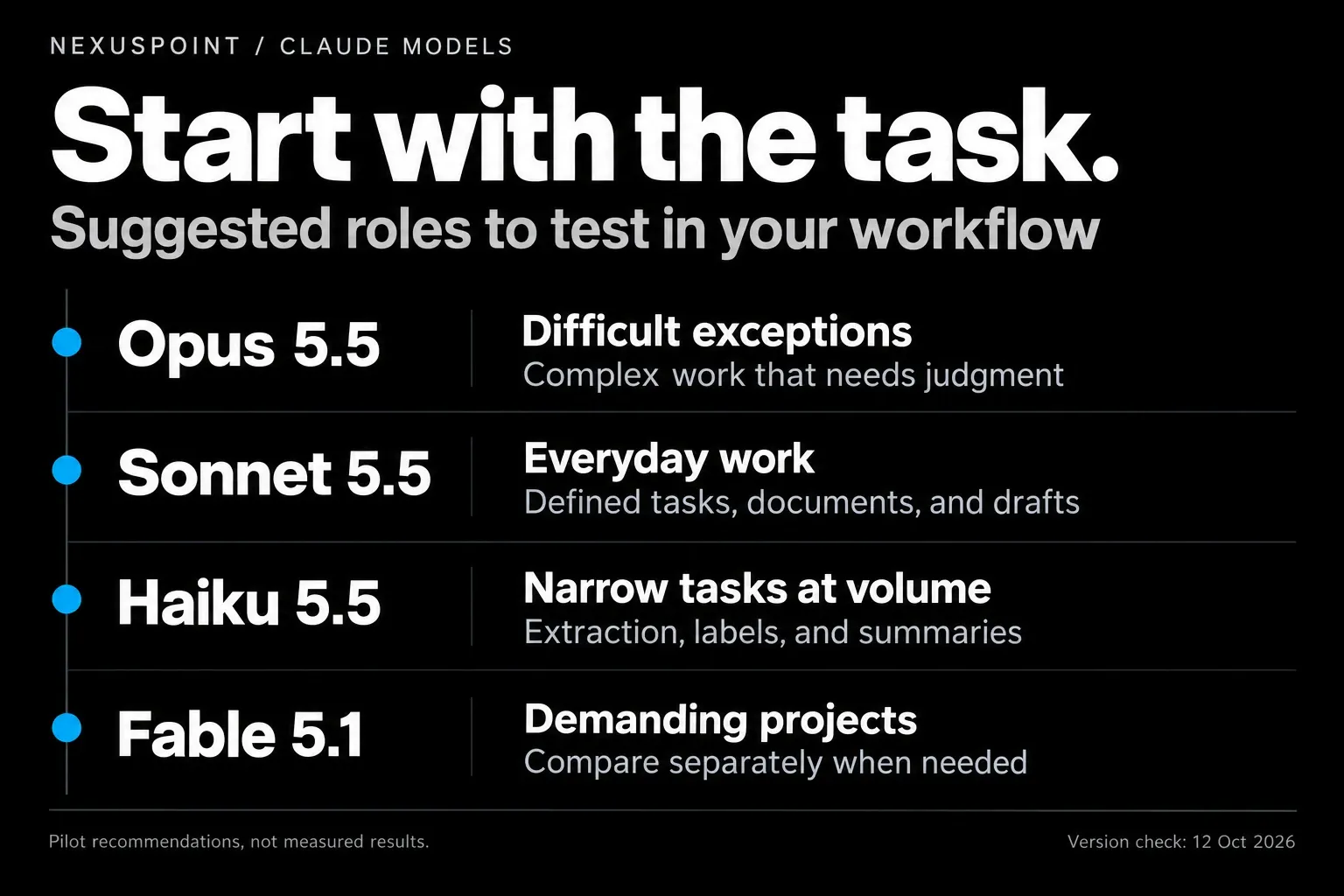
Figure 1. Suggested roles to test against your own work. These are pilot recommendations, not measured results. Versions checked October 12, 2026.
When does Opus 5.5 justify its higher price?
Opus is worth testing when a task requires judgment across several connected decisions. Anthropic says Opus 5.5 performs at Fable 5.1’s level on most work while costing about 40% less to run than Opus 5. That is a vendor-reported comparison, not a savings guarantee for your system. Opus 5.5 announcement.
Consider a broken connection between a website and a customer database. Fixing one missing field may be straightforward. Diagnosing why records disappear only after a retry requires following the data through several steps.
That second task is where we would compare Opus against a cheaper model. Give both the same evidence and acceptance criteria. Check whether the proposed fix works and whether it creates another problem.
A higher token price can still produce a lower total bill if it avoids repeated failed attempts. Equally, using Opus to label every incoming enquiry may spend money without improving the outcome. Let the task earn the extra cost.
Is Sonnet 5.5 the practical starting point for everyday work?
Sonnet is our recommended starting point for a pilot involving clearly defined daily tasks. Anthropic positions Sonnet 5.5 around bug fixes and polished business documents, and reports output generation more than 30% faster than Sonnet 5. The advantage still needs checking against your team’s actual work. Sonnet 5.5 announcement.
A useful example is preparing a weekly account update. The inputs are known: completed tasks, unresolved issues, and the next deadline. The output has a fixed format. A reviewer can check whether the summary missed anything or invented a commitment.
That gives you a clear test. Compare the time to produce an approved update, including editing, against your current process.
Anthropic also reports a 70.6% Terminal-Bench 4.0 score for Sonnet 5.5. That evaluation measures command-line tasks. It supports investigating the model’s coding abilities, but it does not predict how often your account updates will be correct. Published benchmark table.
What role do Haiku 5.5 and Fable 5.1 play?
Haiku and Fable sit at different ends of the buying decision. Anthropic describes Haiku 5.5 as suited to quick, repetitive work. Its Fable 5.1 announcement emphasizes demanding coding and knowledge work. For a business, the useful comparison is whether a particular task needs the additional capability. Haiku announcement, Fable announcement.
For incoming enquiries, we would test Haiku on extracting a company name, requested service, and deadline. The correct output is a short record, not an open-ended recommendation. Missing information should remain missing.
Fable belongs in a separate evaluation when a demanding project still falls short with other available models. Compare the completed work, including review time and cost, rather than assuming its position in the range settles the decision.
There is no requirement to use every model. A workflow that passes its quality checks with one model may be easier to maintain. Add another only when the evidence shows a useful improvement.
How much does Claude 5.5 cost through the API?
Standard API pricing is $4 input and $20 output per million tokens for Opus 5.5, and $2 input and $10 output for Sonnet 5.5. Haiku has separate rates for prompts up to 100,000 tokens and longer prompts. These are usage prices, not Claude subscription fees. Opus pricing, October 7 pricing update.
| Model / prompt size | Input / 1M tokens | Output / 1M tokens | Cache reads / 1M tokens |
|---|---|---|---|
| Opus 5.5, standard mode | $4.00 | $20.00 | $0.20 |
| Sonnet 5.5 | $2.00 | $10.00 | $0.10 |
| Haiku 5.5, up to 100k | $0.10 | $0.50 | $0.01 |
| Haiku 5.5, over 100k | $0.50 | $2.50 | $0.05 |
Checked October 12, 2026. The Haiku prompt threshold selects the pricing tier. Cache writes are charged separately. This table excludes fast mode, batch discounts, regional premiums, tools, and third-party platform charges.
Watch the date on comparisons: Sonnet launched with $0.20 cache reads. Anthropic halved that rate on October 7. Reusing already processed context can therefore change the cost of a repeating workflow.
Why can a cheaper model still make your workflow expensive?
A low token price helps only when the workflow reaches an acceptable result. Compare the total model and tool charges, plus the cost of human checking and correction, across all attempts. Divide that total by the number of accepted results. This is our proposed buying metric, not an Anthropic benchmark.
Imagine 2 assistants drafting support replies. One costs less per attempt but regularly needs rewriting. The other costs more per attempt but leaves the reviewer checking facts and pressing approve. The second may be cheaper once staff time is included.
Record enough detail to explain the difference: retry count, completion time, missing information, and minutes of correction. Keep rejected outputs in the sample. Removing them makes a weak workflow look efficient.
This applies to assistants that answer from your documents, too. A confident answer that points to the wrong policy is expensive even when generating it costs very little.
How would a business use these models in one workflow?
One approach worth testing is to assign a narrow task to Haiku, a routine draft to Sonnet, and difficult exceptions to Opus. Route work using clear rules and check the final records. This is a proposed design for an enquiry workflow, not a claim that NexusPoint has measured its performance.
For example:
- Capture the enquiry. Store the original submission before asking a model to interpret it.
- Extract the details. Test Haiku on service, deadline, and company fields. Validate the structure and required values.
- Prepare a response. Test Sonnet on a draft based on an approved service description. Leave unknown details open.
- Escalate exceptions. Try Opus when the request has conflicting requirements or needs a scope decision. A person approves commitments.
- Check the destination. Confirm the intended record exists and failed attempts did not create duplicates.
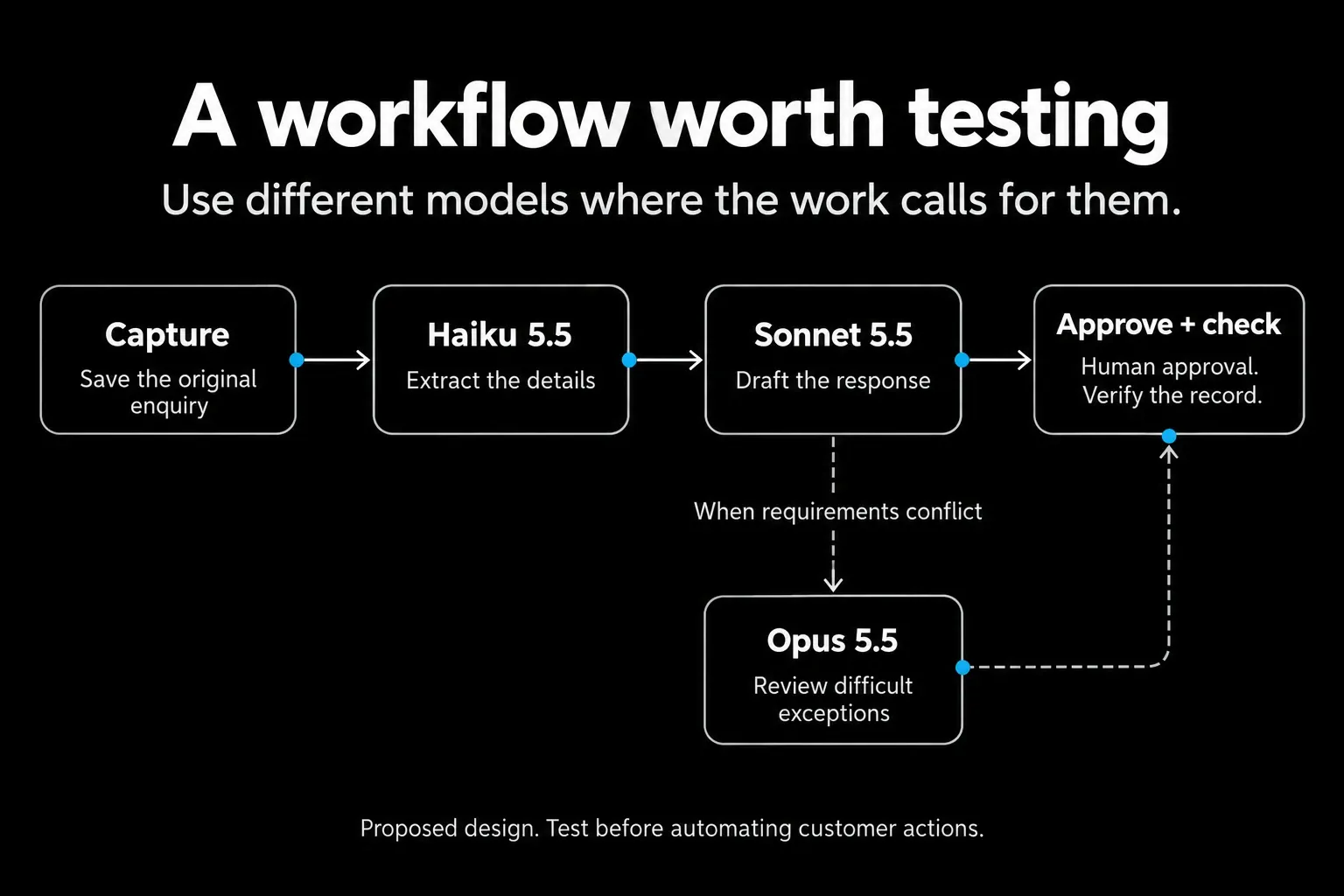
Figure 2. A proposed workflow to test. Opus handles optional exceptions; both routes end with human approval and record verification.
Our guide to connecting a lead form to a CRM covers that final handoff. The model’s response is only one part of the finished system.
What should you test before upgrading an existing automation?
Test the replacement on a fixed sample of work your team already handles, using the same inputs and acceptance criteria as your current setup. Compare accepted results, completion time, review effort, and cost. Our recommendation is to include difficult cases deliberately, rather than choosing only examples that are easy to complete.
For a first pilot, we suggest 20 representative examples. That is a manageable starting sample, not enough to establish production reliability.
Include an incomplete request, conflicting instructions, a duplicate submission, and a tool failure. Define the correct response before running the model. A good result might be an escalation, not a completed answer.
Keep the model version, prompts, and routing rules in the handover so the next release can be compared fairly. The client should own that configuration and the instructions to run it.
Start with one repeating task. If you need help choosing it, book a free 20-minute Ops Teardown. We can map the workflow, identify what can be tested, and define what a useful result would look like.
FAQ
Has Claude Fable 5.5 been released?
As of October 12, 2026, Anthropic’s model listings and system cards identify Fable 5.1. The confirmed Claude 5.5 family consists of Opus, Sonnet, and Haiku. This article does not treat Fable 5.5 as an announced release. Model system cards.
Should a business choose Sonnet 5.5 or Opus 5.5?
Start by testing Sonnet on clearly defined everyday tasks. Compare Opus on tasks involving ambiguity, multiple dependencies, or expensive mistakes. Choose using accepted results, completion time, total cost, and review effort on your own examples.
What does Claude 5.5 cost through the API?
As checked October 12, 2026, standard Opus 5.5 input/output rates are $4/$20 per million tokens, and Sonnet 5.5 rates are $2/$10. Haiku 5.5 rates are $0.10/$0.50 for prompts up to 100,000 tokens and $0.50/$2.50 for longer prompts. Caching, other modes, and platform charges can change the bill. Opus rates, Haiku and Sonnet rates.
Do Anthropic’s reported savings guarantee a cheaper automation?
No. Reported savings describe particular workloads and comparisons. Your cost also depends on prompt length, output length, caching, tool calls, retries, and the work people do to review or correct the result.
Can Claude 5.5 run a customer workflow without review?
A release announcement does not establish that. Test the workflow’s actual outputs and actions. Keep approval for customer messages, commitments, and consequential record changes until your evaluation supports a narrower permission policy.