GPT-6 Astra vs Sol vs Luna: pricing, speed, and what comes next
Compare GPT-6 Astra vs Sol vs Luna on pricing, speed tiers, and business use. See what is confirmed about the roadmap past GPT-8.
- Published
- Reading
- 8 min
- Subject
- Automation
- Written by
- Aleem Ul Hassan

Key takeaways
- Start with GPT-6.1 Sol for complex everyday work, test Luna for routine volume, and use Astra where its added capability earns its cost.
- Standard short-context API input/output prices per million tokens are $10/$50 for Astra, $2/$10 for GPT-6.1 Sol, and $0.10/$0.50 for Luna.
- API speed tiers and Codex subscription allowances use different billing multipliers. Faster output does not guarantee an equally faster workflow.
- No official GPT-7, GPT-8, or later release schedule was verified as of October 15, 2026. Keep future model upgrades testable.
GPT-6 Astra vs Sol vs Luna comes down to the work you need done. Start with GPT-6.1 Sol for complex everyday tasks, test Luna for routine volume, and use Astra where harder reasoning justifies the cost. Choose the speed tier separately, then measure the finished result.
Checked October 15, 2026. This comparison uses OpenAI’s published documentation. NexusPoint has not run a controlled benchmark of these models; the workflow recommendations below are our analysis.
Using the same expensive model for every task can waste budget as volume grows. A system that sorts incoming requests, drafts a project brief, and investigates exceptions contains several different jobs. Each can have its own cost and quality threshold.
Here is what the current family offers, how the bills change, and what the roadmap actually supports.
What changed in the GPT-6 model family?
The current comparison is GPT-6 Astra, GPT-6.1 Sol, and GPT-6 Luna. Sol received an update after the original GPT-6 family expansion, so a comparison that only says “GPT-6 Sol” can hide a meaningful version difference. Record the exact model ID when evaluating a workflow or checking an invoice.
OpenAI introduced GPT-6 Astra on September 3. Its Sol and Luna expansion followed on September 22, then GPT-6.1 Sol arrived on September 29.
The current API IDs are gpt-6-astra, gpt-6.1-sol, and gpt-6-luna.
Original GPT-6 Sol remains a separate option. Its Standard input and output prices match 6.1 Sol, but cached input is $0.20 per million tokens instead of $0.10. “Sol” alone is too vague for a useful cost comparison.
Which model should a business choose?
Use Sol as the starting candidate for complex daily work, Luna for narrow tasks repeated at volume, and Astra for difficult work where mistakes or repeated attempts are expensive. Those are sensible testing priorities based on the models’ documented roles. Your own acceptance checks should decide which model gets deployed.
| Model | Good starting point for a pilot | What to check before committing |
|---|---|---|
| GPT-6 Luna | Sorting requests, extracting fields, and producing routine summaries | Missing details, ambiguous inputs, and exception handling |
| GPT-6.1 Sol | Drafting briefs, coding, research, and workflows with several steps | Accuracy, tool results, and the amount of review needed |
| GPT-6 Astra | Difficult investigations, complex code changes, and demanding reasoning | Whether better outcomes justify the higher total cost |
Sources for the model roles: OpenAI’s Luna documentation, 6.1 Sol announcement, and Astra documentation. The pilot examples are NexusPoint recommendations.
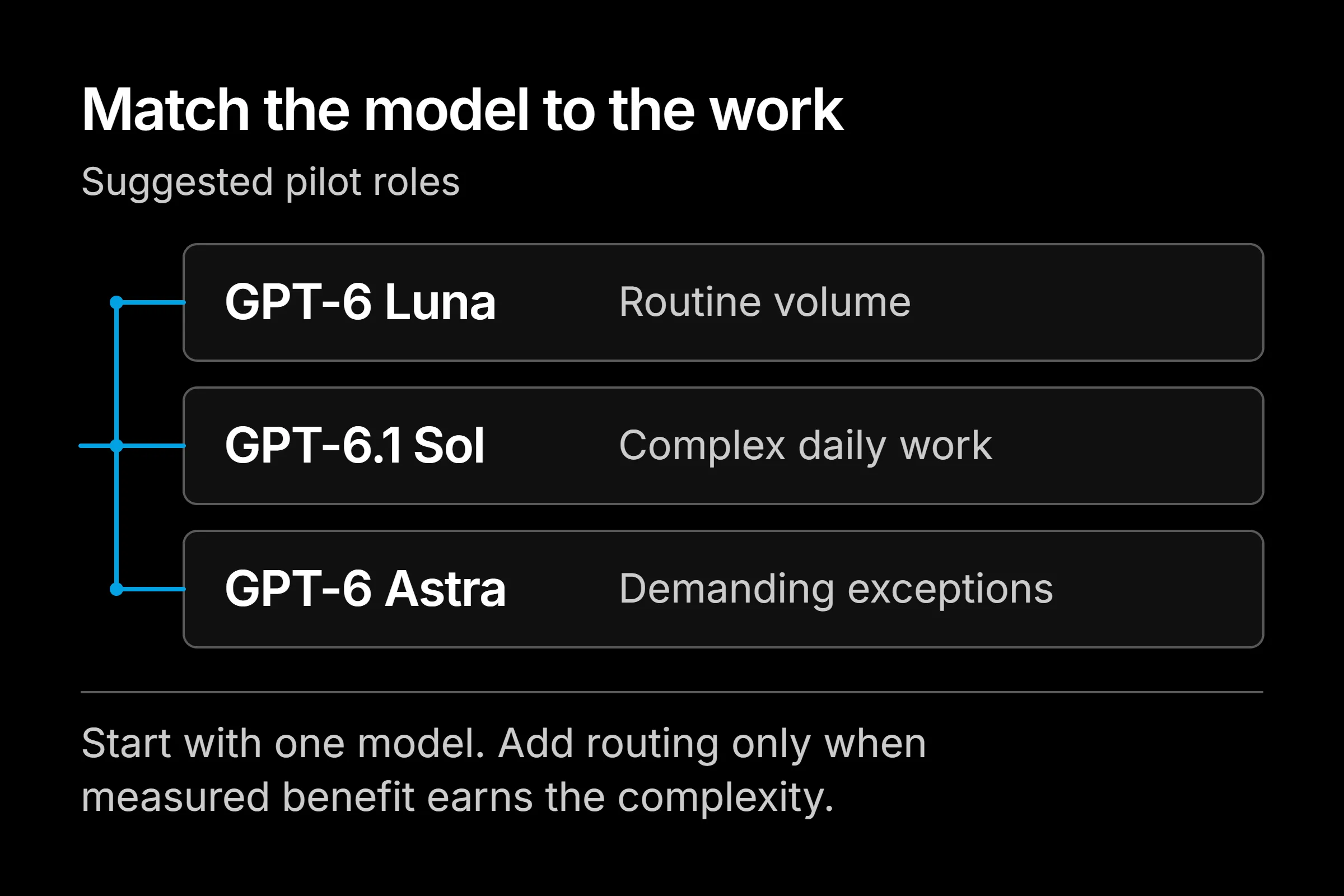
Figure 1. Suggested pilot roles, not benchmark rankings. Start with one model and add routing only when measured benefits justify the complexity.
For a document assistant, better model selection still depends on approved sources and answer checks. Paying more does not fix an outdated policy document.
How much do Astra, Sol, and Luna cost?
Standard API pricing puts Astra at five times GPT-6.1 Sol’s input and output rates, while Luna costs one twentieth of Sol on those same measures. Cached reads and cache writes have separate prices. Use the rates for your actual prompt length and processing tier when estimating the bill.
All figures below are USD per 1 million text tokens, for Standard processing with prompts up to 272,000 input tokens, checked October 15, 2026.
| Model | Input | Cached input read | Cache write | Output |
|---|---|---|---|---|
| GPT-6 Astra | $10 | $1 | $12.50 | $50 |
| GPT-6.1 Sol | $2 | $0.10 | $2.50 | $10 |
| GPT-6 Luna | $0.10 | $0.01 | $0.125 | $0.50 |
Above 272,000 input tokens, long-context pricing applies to the full request: input and cache rates double, and output rates rise by 50%. These are token charges; tools and other services can add costs. OpenAI’s API pricing.
Reasoning tokens count as billable output, even when they are not visible in the final answer. A short reply can still involve substantial reasoning. OpenAI’s reasoning guide.
What would a workflow cost at those rates?
A useful estimate starts with tokens consumed per completed job. For an illustrative request using 10,000 uncached input tokens and 2,000 billable output tokens, Standard token charges would be $0.20 on Astra, $0.04 on GPT-6.1 Sol, and $0.002 on Luna. Those figures assume identical usage, not identical quality.
| Model | Token cost per example request | Token cost for 1,000 requests |
|---|---|---|
| GPT-6 Astra | $0.20 | $200 |
| GPT-6.1 Sol | $0.04 | $40 |
| GPT-6 Luna | $0.002 | $2 |
NexusPoint calculation: input tokens / 1,000,000 x input rate, plus billable output tokens / 1,000,000 x output rate. No caching, retries, tools, or premium speed tier included.
Actual usage will differ between models. More attempts or longer reasoning can change the comparison.
For a business, track cost per accepted result alongside review time. A cheaper request that produces an incomplete client brief can create more work than it saves. The token bill is only part of the decision.
Which API speed tier should you pay for?
Choose the processing tier around the deadline. Standard is the baseline, Batch and Flex trade immediacy for lower prices, and Fast or Ultrafast cost more to reduce waiting. A premium tier earns its place when the saved time matters to the workflow, such as an operator waiting for the next action.
| API tier | Price relative to Standard | Main trade-off |
|---|---|---|
| Standard | 1x | Baseline processing |
| Batch | 0.5x | Asynchronous processing within 24 hours |
| Flex | 0.5x | Slower responses and occasional resource unavailability |
| Fast | 2x | Guide advertises speeds up to 2.5x faster |
| Ultrafast | 6x | Available for Astra and 6.1 Sol, with separate rate limits |
Sources: OpenAI’s Batch, Flex, Fast, and Ultrafast guides. Confirm support for your model and account.
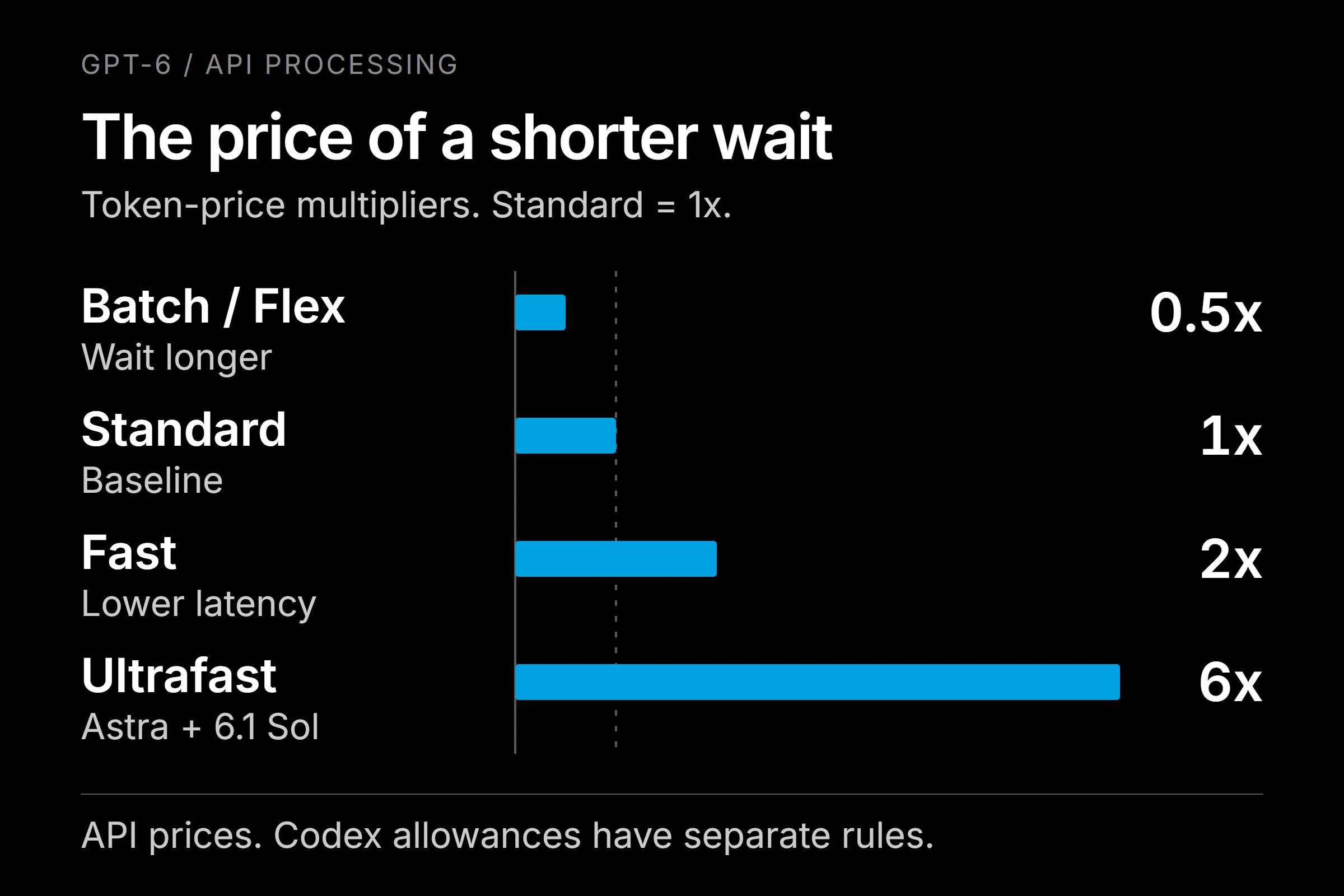
Figure 2. API token-price ratios, not speed guarantees. Codex subscription allowance rates differ. Sources: OpenAI’s processing guides linked above, checked October 15, 2026.
An overnight classification job is a candidate for Batch. An interactive task may benefit from Fast. Measure elapsed time for the whole job, because searches, tool calls, and external systems still contribute to the wait.
Are API prices the same as Codex subscription usage?
API processing prices and Codex subscription allowances use different multipliers. In Codex and ChatGPT Work, Fast consumes included allowance at 2.5x and Ultrafast at 8x. Purchased credits use 2x and 6x respectively. The API table above cannot tell you how quickly a subscription’s included allowance will be used.
These rules come from OpenAI’s speed documentation for Codex and Work, which also describes plan and model eligibility.
The same documentation says Astra Ultrafast can generate output tokens up to 8x faster in Codex. That is a token-generation claim. A task involving a slow website, multiple tool calls, or human review can have a much smaller improvement in completion time.
Before paying for speed, identify where the delay occurs. Faster generation helps most when generation is the part holding up the person doing the work. It will have less effect when the workflow spends most of its time waiting on another service.
What is confirmed about the roadmap past GPT-8?
We could not verify an official GPT-7, GPT-8, or later release schedule as of October 15, 2026. The sources reviewed do not establish future launch dates, prices, or named model capabilities. Treat any detailed sequence extending past GPT-8 as speculation unless it links to a specific, current OpenAI announcement.
OpenAI does publish a broader view of progress. Its AI progress and recommendations discusses expectations for small scientific discoveries in 2026 and more significant discoveries in 2028 and beyond, while acknowledging uncertainty.
Those are forecasts about scientific progress. They do not assign GPT version numbers to particular years.
For an operating business, a useful roadmap starts with the work you can improve now. A confirmed model with clear acceptance checks is enough to test a bounded workflow. Future releases become candidates for comparison when they are available, with their actual terms and prices.
How do you build now and keep future upgrades manageable?
Keep the business rules, source documents, and acceptance checks outside the model. Then a new release can be evaluated against the same work without redesigning the entire process. Model choice should be a documented setting in a system your team understands, with a clear way to restore the previous version.
For a client-request workflow, that means:
- Define the finished result. The brief must identify the right client, capture requirements, and flag missing information.
- Test realistic exceptions. Include conflicting dates, duplicate names, incomplete requests, and documents the system should not access.
- Compare total effort. Record model settings, token costs, elapsed time, failures, and human corrections.
- Add routing only when it earns its upkeep. Luna might extract fields, Sol might draft the brief, and Astra might handle difficult exceptions. At low volume, one reliable model can cost less once maintenance is included.
- Hand over the operating details. Your team should know how to update sources, change models, and recover from a failed run.
That last step is part of what we hand over with a system.
Have a repeating task that needs this kind of evaluation? Talk to NexusPoint about the workflow. Bring the task, the tools involved, and an example of a correct result.
FAQ
Is GPT-6.1 Sol the same as GPT-6 Sol?
No. GPT-6.1 Sol is the newer Sol release, announced September 29, 2026. Original GPT-6 Sol remains a separate model. Check the exact model ID when comparing cost or performance.
Which GPT-6 model is cheapest?
GPT-6 Luna has the lowest Standard short-context API token prices of these three: $0.10 per million input tokens and $0.50 per million output tokens. Total workflow cost also includes retries, tools, and review.
Does Fast mode make a workflow twice as fast?
There is no universal end-to-end speed multiplier. API Fast mode costs twice Standard, while the guide advertises speeds up to 2.5 times faster. Tool calls and other waiting time still affect completion.
Can GPT-6 Luna use API Ultrafast mode?
The official Ultrafast documentation reviewed on October 15 lists GPT-6 Astra and GPT-6.1 Sol. It does not list GPT-6 Luna. Verify model and account availability before budgeting for the tier.
Is there an official roadmap past GPT-8?
We could not verify an official GPT-7, GPT-8, or later release schedule as of October 15, 2026. OpenAI’s broader forecasts about scientific progress do not establish model version names, launch dates, or prices.