Gemini 4 Argon: benchmarks, availability, and the "world's smartest" claim
Gemini 4 Argon benchmarks, access, and pricing explained. See what the world's smartest AI claim means for your business workflows.
- Published
- Reading
- 9 min
- Subject
- Automation
- Written by
- Aleem Ul Hassan
Key takeaways
- Argon leads selected benchmarks, but rankings change with the task and model settings.
- Current official access is restricted. Paid API and Ultra access remain planned.
- Evaluate quality, time, review effort, and cost per accepted result before adopting.
Gemini 4 Argon has strong results in software engineering and business workflow tests. The evidence supports taking it seriously, but a blanket “world’s smartest AI” verdict goes further than the results justify. Access is also restricted, with selected trusted defenders receiving the model through Google’s Fairwind Program.
Research note: This article analyzes published results. NexusPoint has not conducted hands-on Argon tests.
For a business owner, that creates a practical decision: which part of your operation might benefit enough to justify testing a new model?
A better research assistant could reduce the time spent checking documents. A better coding model could help maintain your software. Neither improvement automatically fixes a workflow that sends information to the wrong customer.
Our recommendation: treat Argon as a candidate for specific, demanding tasks. Keep your buying decision tied to work completed correctly, the time it takes, and the cost of checking it.
What is Gemini 4 Argon built to do?
Gemini 4 Argon is Google’s frontier model for demanding software engineering, enterprise knowledge work, and cybersecurity defense. Its focus is sustained reasoning across tasks with many steps. That makes it relevant to teams working through complex documents, large code changes, or investigations that need more than a quick answer. Google DeepMind’s model page.
Google’s September 30 announcement highlights a 1-million-token output limit, expanded from 64,000. Output capacity is the space available for reasoning and generation. It is a different specification from the input context window, which describes how much material a model can take into account. Google’s Argon announcement.
More room can help with extended work. It also makes cost and completion time worth measuring. A model able to produce a long response still needs to produce the right one.
For everyday work, the question is whether that extra capacity changes the result your team needs.
Where do Gemini 4 Argon’s benchmarks show wins and losses?
Argon leads several specialist evaluations, but the coding results are mixed. Google’s published comparison puts it ahead on DeepSWE and behind on FrontierSWE and Terminal-bench. Those tests measure different kinds of work. A lead in one does not establish that the model will perform best throughout your development process.
These are selected rows from Google’s comparison, checked on October 8, 2026. They are benchmark-specific percentages, not interchangeable intelligence scores.
| Benchmark | Gemini 4 Argon | GPT-6 Astra | Claude Opus 5.5 |
|---|---|---|---|
| DeepSWE v1.1 | 77.9% | 74.1% | 74.2% |
| FrontierSWE v2 | 55.0% | 65.5% | 62.3% |
| Terminal-bench 4.0 | 57.4% | 58.2% | 66.4% |
| Vals Finance Agent v2 | 65.4% | 53.5% | 58.6% |
| LVBench, long video understanding | 91.7% | 87.5% | 83.7% |
| OSWorld-2.0, offline subset, partial score | 69.2% | 72.6% | Not reported |
Source: Google DeepMind’s benchmark table. Bold marks the highest reported value among the models shown. A missing value is not a zero.
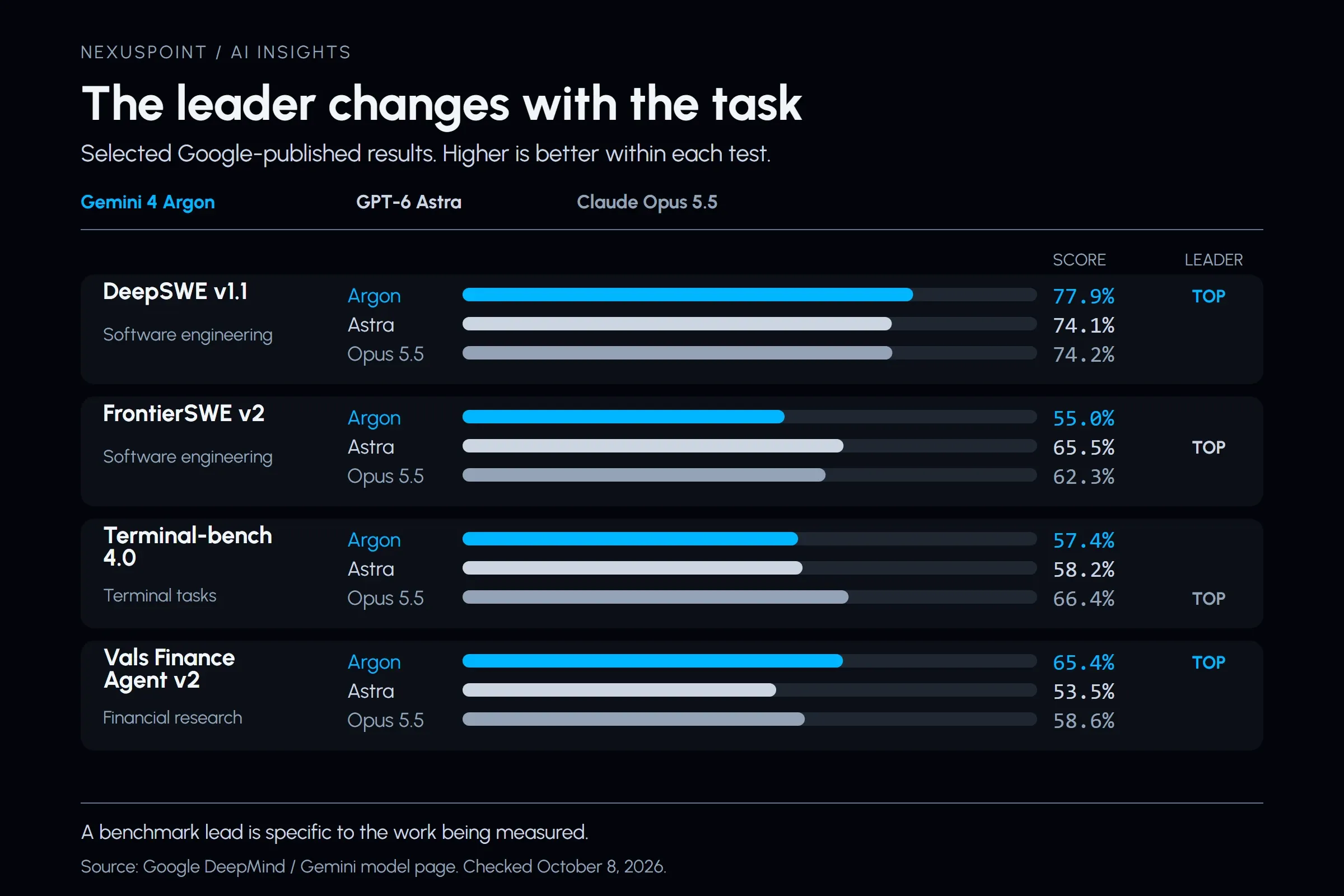
Figure 1. Leadership changes by task. Selected Google-published results, checked October 8, 2026.
How comparable are the benchmark results?
The launch table combines results from different evaluators and configurations. It is useful evidence, but it is not a single controlled experiment where every model ran every task under identical conditions. Before applying a score to your business, check who measured it, the tools available, and the time or reasoning budget.
Google’s evaluation methodology says Argon generally uses a single attempt and the highest thinking settings, with exceptions. Google computes some scores itself and takes others from benchmark organizations. Rival scores also come from provider reports or public leaderboards.
The details matter. The video evaluation gives models different frame allowances because of API limits. OSWorld reports a partial score on an offline subset and selects Argon’s best result across 3 runs.
Use these results to choose what to investigate. Then run the work your team actually does, under the conditions you can afford.
Is Gemini 4 Argon really the “world’s smartest AI”?
Argon’s results support leadership claims for particular evaluations. They do not establish a universal title. Text preference, financial research, coding, and cross-app execution are different measurements. A useful claim identifies the evaluation, model setting, and date, then leaves room for the results of other tests.
There is real evidence behind the excitement. Arena’s October 2 Text Arena Overall snapshot ranks gemini-4-argon-high first at 1525 +/- 9, with 4,932 votes. Arena labels the result preliminary. That is evidence of preference in those text comparisons. Arena’s text leaderboard.
Another view is less dominant. Artificial Analysis’s Argon High page reports an Intelligence Index score of 53, with its summary showing #8 out of 225 in the displayed comparison class when checked on October 8. Artificial Analysis’s model evaluation.
Google’s announcement, authored by Koray Kavukcuoglu, uses the phrase “frontier performance in complex workflows.” That is a more specific claim than universal superiority. Google’s announcement.
What do the independent business benchmarks tell us?
Independent evaluations give Argon a credible case for business work, alongside limits that matter in deployment. A strong ranking can justify a pilot. It cannot tell you the error rate on your customer records or the amount of checking your staff will need to do. Those require your own evaluation.
Zapier’s AutomationBench v1.0.6 lists Argon High first at 51.29%. The benchmark tests cross-app workflows and scores the final business state against fixed criteria. Its headline metric requires all scored conditions to pass. Zapier’s AutomationBench.
Leading at roughly half of these demanding tasks is meaningful progress. It also argues for checking the resulting records before letting a system operate without supervision. This score is not a forecast that half of your automations will fail.
Vals AI’s October 6 Finance Agent v2 leaderboard places Argon first at 65.40%. It reports $4.38 per test and 16m21s duration, versus 61.44%, $2.00, and 3m21s for Gemini 3.8 Flash. Vals AI’s Finance Agent evaluation.
For a demanding research task, the difference may be worth paying for. For a time-sensitive request, the trade-off needs a closer look.
Can businesses use Gemini 4 Argon now?
As of October 8, 2026, the official sources reviewed describe restricted early access. Selected trusted defenders receive Argon through Fairwind, while broader developer and consumer access remains planned. A benchmark listing or published price does not establish that an ordinary business account can start using the model today.
Google identifies paid API customers and Google AI Ultra subscribers as the starting groups for the broader release. Its announcement gives no firm date. Google’s rollout announcement.
The public Gemini API model catalog and API release notes reviewed for this article contained no Argon entry. That supports the restricted-access reading, although these pages can change.
Fairwind is an approval-based defensive program. Selected partners receive access, and the program prohibits sharing, redistributing, or selling it. Fairwind’s access rules.
For a current project, keep delivery tied to models your account can use. Add Argon to the evaluation when access is confirmed.
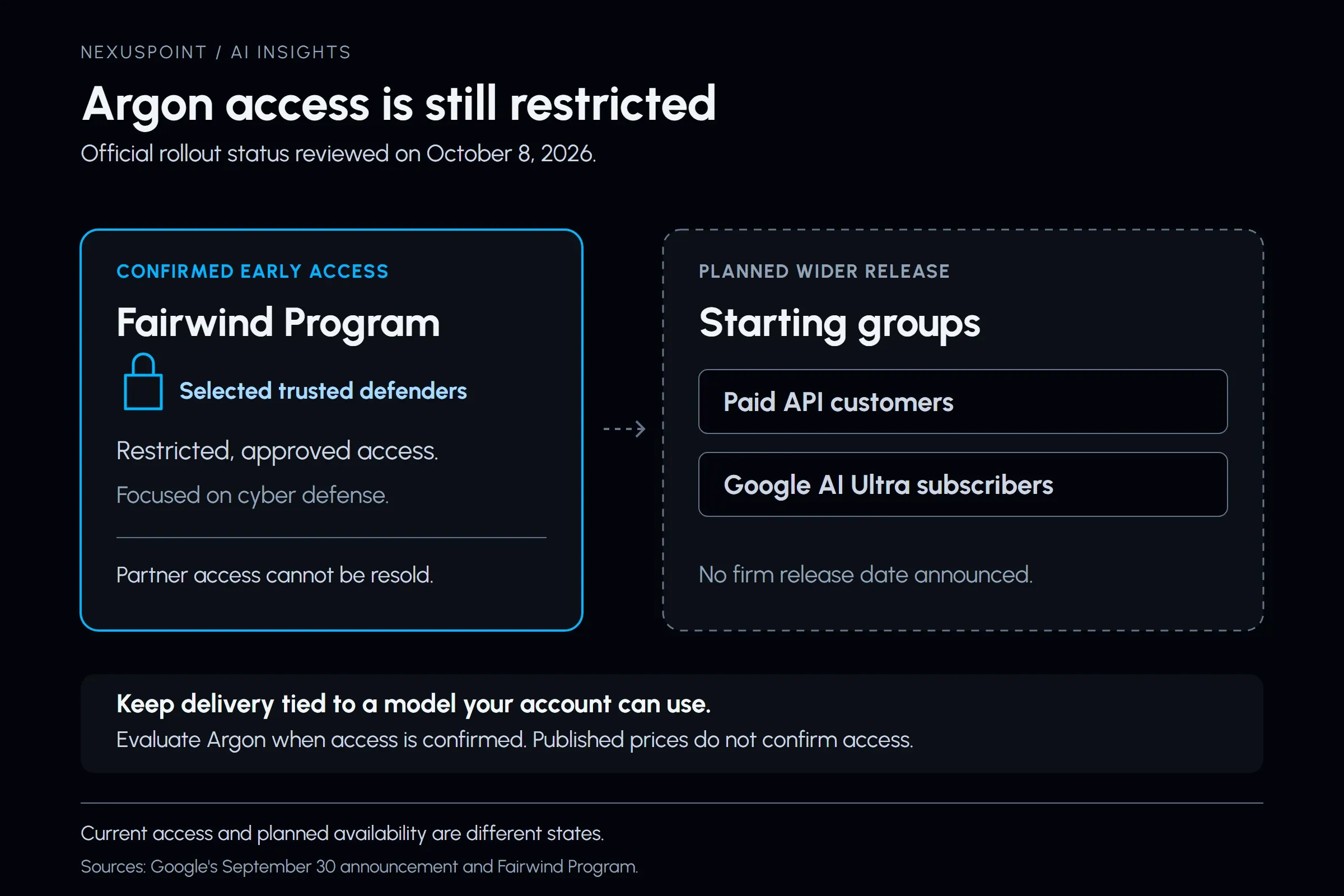
Figure 2. Confirmed early access and the planned wider release are separate states. Sources: Google’s rollout announcement and Fairwind Program, reviewed October 8, 2026.
What pricing has Google announced?
Google has announced introductory and later token rates, but the announcement does not give an end date for the introductory period. These are announced prices for the rollout. Your running cost will also depend on how much work the model performs, how often it retries, and which other services the workflow uses.
| Announced pricing period | Input per 1 million tokens | Output per 1 million tokens |
|---|---|---|
| Introductory | $2 | $10 |
| After the introductory period | $4 | $20 |
Google also announces a 95% discount on cached input tokens. Google’s pricing announcement.
For budgeting, track cost per accepted result. Include the time a person spends correcting or verifying the output. A cheaper call that creates more review work may cost the business more overall.
Keep token, platform, and staff costs visible separately. That makes the case for switching easier to assess.
How should a business evaluate Argon?
Start with a narrow workflow and a written definition of success. Compare Argon with your current system once access is available. Measure the final result, elapsed time, total cost, and review work. Include difficult cases from your actual operation, because polished demonstrations rarely reveal where the process breaks.
For example, consider a system that turns incoming client requests into draft project briefs. Success means using the correct client documents, extracting the requirements accurately, identifying missing information, and leaving the right record in your project tool.
Our recommended pilot:
- Build a small test set. Include routine requests, incomplete briefs, conflicting information, and duplicate client names.
- Define unacceptable errors. Mixing client records or inventing an agreed deadline should fail the task.
- Compare under realistic conditions. Use the same documents and tool permissions. Record model settings and budgets.
- Check the resulting state. Verify the saved brief and project record, alongside the model’s response.
- Keep review where it earns its cost. Approve external messages and important record changes until testing supports greater autonomy.
What does this mean for your AI systems?
Argon gives businesses another model worth evaluating for demanding work. The stronger move is to make your workflow measurable and keep model choice flexible. You should be able to identify where a new model improves the result, how much it costs, and how to switch back if performance drops.
That means keeping your business rules, test cases, and documentation outside the model. Write down who owns exceptions. Record failures so the next change can be checked against the same evidence.
At NexusPoint, we build websites and automations for teams whose repeating work has outgrown their capacity. The system and its documentation belong to the business. That ownership should include a clear view of what the AI does and how its work is checked.
Have a workflow your team keeps doing by hand? Talk to NexusPoint about automating it. Bring the task, the current tools, and the result you need.
FAQ
Is Gemini 4 Argon publicly available?
The official sources reviewed on October 8 describe restricted early access for selected trusted defenders. Broader access is planned, with no firm date given. Google’s rollout announcement.
Is Argon better than GPT-6 Astra or Claude Opus 5.5?
Performance varies by task. The selected comparison above shows Argon winning some tests and trailing on others. Use the evaluation closest to your workflow to decide what to pilot. Google’s comparison.
Are all Gemini 4 Argon benchmarks independent?
No. Google’s launch comparison mixes its own measurements with results from benchmark organizations and provider reports. The methodology identifies the sources and conditions. Google’s evaluation methodology.
Does a 1-million-token output limit guarantee better work?
No. More capacity allows longer reasoning and generation. It does not guarantee accurate answers, correct tool actions, or a useful finished result.
Should we wait for Argon before building an automation?
Proceed with a model your team can access and test. Keep the workflow documented and measurable so Argon can be compared later without rebuilding the whole system.